Civicorum™ LLC Corporate Governance Resources
CPA-inspired tools, templates, and guidance designed to help LLC owners organize, document, and maintain proper corporate governance.
Designed to support internal recordkeeping and professional review.

Civicorum™
How This Binder Works
The Civicorum™ LLC Corporate Governance Record Book is designed to help LLC owners establish and maintain organized, well-documented governance practices. This binder serves as a centralized record of key company documents, decisions, and supporting information commonly requested by banks, accountants, attorneys, and other third parties.
The physical binder provides a structured framework for organizing your LLC’s governing documents, while the accompanying digital resources accessible through this site are intended to support consistent documentation and ease of use. Together, they help promote clarity, continuity, and professionalism in your business records.
Use this binder to:
• Maintain formation and governing documents in a single location
• Document significant company decisions through meeting minutes and written resolutions
• Track ownership, membership interests, and key administrative information
• Support banking, tax, and compliance-related requests
• Establish a clear historical record of your LLC’s governance activities
The materials provided are designed for organizational and educational purposes and should be customized as appropriate for your specific business circumstances. The digital resources are intended to supplement not replace the governing documents maintained in the physical binder.
Navigation

Civicorum™ Resources
These resources are provided to support proper LLC organization, documentation, and ongoing corporate governance. The documents and reference materials in this section are designed to work in coordination with your physical Civicorum™ Corporate Governance Record Book, creating a centralized and durable system of record.Each resource is provided as a professionally formatted PDF and may be completed electronically or in print, then customized to reflect your company’s specific ownership structure, management model, and operational needs. Where applicable, documents are aligned with common requirements of banks, accountants, attorneys, and other third parties.Important usage note:
Certain documents in this section contain fillable fields. For best results, these PDFs should be opened in a standard PDF viewer (such as Adobe Acrobat or your browser’s built-in PDF reader). Some web-based preview modes may not support interactive form fields. Downloading the document ensures full functionality and proper saving of completed information.How to use these resources:- Begin with your Organizational Documents to establish your company’s foundational records- Use Exhibits and Resolutions to document ownership, authority, and key company actions- Reference tax-related and informational materials when completing filings or responding to professional requests- Maintain completed documents in your Civicorum™ binder to support continuity, compliance, and institutional memoryThese materials are provided for educational and organizational purposes only and do not constitute legal or tax advice. Users are encouraged to consult qualified professionals regarding state-specific requirements, regulatory obligations, or complex matters.

Articles of Organization
Articles of Organization — Overview & GuidanceThe Articles of Organization are the document filed with the state to legally form a limited liability company. Once accepted, the Articles establish the LLC’s existence and basic structure under state law.While relatively brief, the Articles are a critical foundational document and are frequently requested by banks, lenders, and other third parties as proof that the LLC was properly formed.What the Articles of Organization DoThe Articles of Organization generally:
• Create the LLC as a legal entity under state law
• Identify the LLC’s legal name and state of formation
• State the management structure (member-managed or manager-managed)
• Identify the registered agent
• Establish the effective date of formationThe Articles are a public, state-facing document and typically contain only high-level information.How Articles of Organization Relate to the Operating Agreement• The Articles of Organization establish the LLC with the state
• The Operating Agreement governs the LLC’s internal operationsIf there is ever a question about internal governance, the Operating Agreement controls, provided it is consistent with state law and the Articles.For this reason, Civicorum™ Articles are intentionally streamlined, while governance details are handled in the Operating Agreement and supporting documents.Choosing the Correct Articles of OrganizationSelect the Articles of Organization that match your LLC’s management structure.Single-Member LLC
• One owner
• May be member-managed or manager-managedMulti-Member LLC
• Two or more owners
• Typically member-managed unless otherwise designatedManager-Managed LLC
• One or more managers appointed to run the business
• Ownership and management authority are clearly separatedThe management structure selected in the Articles should match the structure used in the Operating Agreement and related governance documents.Practical Guidance• Articles of Organization are filed once at formation
• Amendments may be required if key information changes
• Most states do not require Articles to be updated for routine internal changes
• Banks often request a copy of the filed Articles, even years after formationCivicorum™ Articles of Organization are designed to be state-agnostic, clear, and compatible with the Operating Agreements and governance documents provided in this resource library.
Documents open in your browser for review. Downloading enables full form completion, saving, and printing.
Operating Agreements
Operating Agreements — Overview & GuidanceAn Operating Agreement (OA) is the foundational governance document of a limited liability company. It establishes how the LLC is owned, managed, and operated, and defines the rights, responsibilities, and authority of the members and/or managers.While not always required to be filed with the state, a properly drafted Operating Agreement is considered a best practice and is commonly requested by banks, CPAs, lenders, investors, and other third parties.Civicorum™ Operating Agreements are designed to be:
• Practical and easy to use
• CPA-review friendly
• Bank-ready
• Aligned with common state law requirementsWhy an Operating Agreement MattersAn Operating Agreement helps:
• Establish limited liability protection
• Clarify ownership and management authority
• Prevent disputes between owners
• Document internal governance decisions
• Support banking, tax, and compliance needsEven single-member LLCs benefit from having an Operating Agreement on file, as it helps demonstrate that the business is operated separately from the individual owner.Even when not legally required, an Operating Agreement is often requested by banks and tax advisors.How to Choose the Right Operating AgreementCivicorum™ provides Operating Agreements tailored to the most common LLC structures. Choose the version that matches how your LLC is managed, not just how many owners you have.Single-Member Operating AgreementUse this if:
• The LLC has only one owner
• The sole member manages the business directlyThis version is streamlined for simplicity while still providing strong governance and liability protection.Multi-Member, Member-Managed Operating AgreementUse this if:
• The LLC has two or more members
• All members participate in management and decision-makingThis version outlines voting rights, capital contributions, profit distributions, and shared management authority.Manager-Managed Operating AgreementUse this if:
• The LLC appoints one or more managers to run the business
• Some members may be passive investorsThis version clearly separates ownership from management authority, which is especially important for banking, tax, and legal clarity.Relationship to Other Governance DocumentsYour Operating Agreement works together with other Civicorum™ documents:• Articles of Organization
• Filed with the state to form the LLC
• The OA governs internal operations after formation• Meeting Minutes & Written Consents
• Document actions taken under the authority granted by the OA• Resolutions
• Approve specific actions (banking, tax elections, contracts, etc.)Together, these documents create a complete governance record for your LLC.
Documents open in your browser for review. Downloading enables full form completion, saving, and printing.
Exhibits to Operating Agreements
Operating Agreement Exhibits — OverviewOperating Agreement Exhibits are supporting schedules that provide specific details referenced in the main body of the Operating Agreement, such as ownership information, capital contributions, or management designations.All Civicorum™ Operating Agreements include the appropriate exhibits already attached and fully integrated. The standalone exhibit downloads are provided solely for convenience.When to Use Standalone ExhibitsYou may wish to download a standalone exhibit if:
• You need to update or replace a specific schedule
• A bank, CPA, or third party requests only a particular exhibit
• You are maintaining or reorganizing your internal records
• You prefer not to re-download the full Operating AgreementStandalone exhibits are intended to be used in conjunction with the applicable Operating Agreement and should be kept with the governing document in your records.Practical Notes• Exhibits do not replace the Operating Agreement
• Any updates should remain consistent with the Operating Agreement
• Changes to exhibits may require a formal amendment, depending on the nature of the updateCivicorum™ exhibits are formatted to match the corresponding Operating Agreements for seamless integration and professional presentation.
Documents open in your browser for review. Downloading enables full form completion, saving, and printing.
Resolutions
Resolutions — OverviewResolutions are formal written actions used to approve and document specific decisions made by an LLC. They serve as clear evidence that a particular action was properly authorized under the Company’s Operating Agreement.Resolutions are commonly requested by banks, CPAs, lenders, and other third parties because they clearly identify who approved an action and what authority was granted.What Resolutions Are Used ForResolutions are typically used to approve or document actions such as:
• Opening or modifying business bank accounts
• Authorizing signers or managers
• Electing S-Corporation tax status
• Entering into significant contracts or financing arrangements
• Approving loans, leases, or credit facilities
• Appointing officers or managers
• Ratifying prior actionsResolutions focus on specific actions, not ongoing governance.Resolutions vs. Meeting Minutes vs. Written ConsentThese documents work together but serve different purposes:Meeting Minutes
• Document what occurred during a meeting
• Capture discussion, attendance, and votesWritten Consent (In Lieu of Meeting)
• Approves actions without holding a meeting
• Used when all required parties agreeResolutions
• Clearly state and authorize a specific action
• Often referenced within minutes or written consents
• Frequently provided to third parties as standalone proof of authorityIn many cases, a resolution is attached to or referenced by meeting minutes or a written consent.Who Adopts ResolutionsResolutions should be adopted by the party with authority under the Operating Agreement:Single-Member LLCs
• Sole Member adopts resolutionsMember-Managed LLCs
• Members adopt resolutionsManager-Managed LLCs
• Managers adopt resolutions
• Members typically do not vote on day-to-day actionsUsing the correct resolution ensures consistency with the Company’s governance structure.Practical Guidance• Use resolutions to document important but specific actions
• Keep resolutions with your Operating Agreement and meeting records
• Banks often require a copy of a signed resolution before acting
• Resolutions may be reused or updated as circumstances changeCivicorum™ resolutions are designed to be clear, professional, and bank-ready, and to integrate seamlessly with the Operating Agreements, meeting minutes, and written consents provided in this resource library.
Documents open in your browser for review. Downloading enables full form completion, saving, and printing.
Meeting Minutes & Written Consents
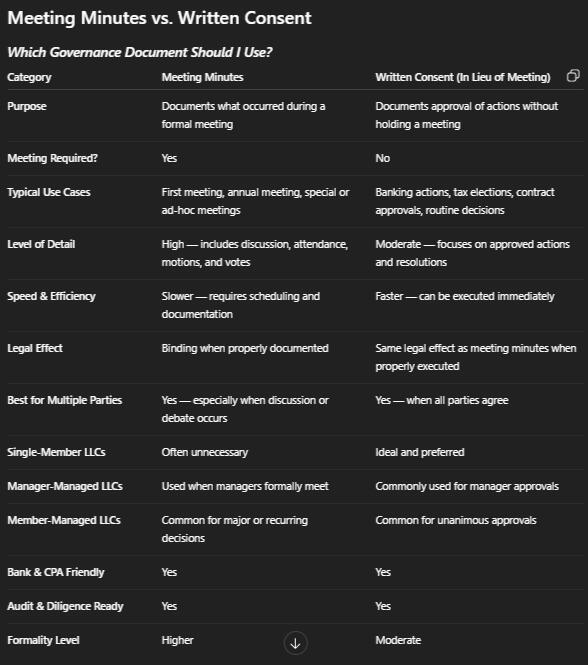
Meeting Minutes & Written Consents — OverviewLimited liability companies are not required in every state to hold formal meetings. However, maintaining written records of key company decisions is a best practice and is frequently requested by banks, CPAs, auditors, investors, and other third parties.Meeting minutes and written consents serve as the Company’s official record of governance actions, demonstrating that decisions were properly authorized and documented in accordance with the Operating Agreement.Civicorum™ provides both Meeting Minutes and Written Consent templates so you can choose the format that best fits your LLC’s structure and situation.How to Choose the Right DocumentUse Meeting Minutes when:• A formal meeting was held (Initial, Special, or Annual)
• Multiple members or managers participated in discussion
• You want a detailed record of attendance, discussion, motions, and votesUse Written Consent in Lieu of Meeting when:• No meeting was held
• All required parties agree to the action
• You want a faster, simpler approval process
• You are approving:
• Banking actions
• Tax elections
• Contract approvals
• Routine or unanimous decisionsWritten consents carry the same legal effect as meeting minutes when properly executed and are commonly used for banking actions, tax elections, contract approvals, and other routine matters.Management Structure MattersBe sure to select documents that match your LLC’s management structure:Member-Managed LLCs should use Member meeting minutes or Member written consentsManager-Managed LLCs should use Manager-specific documentsSingle-Member LLCs may use Single-Member Written Consents in place of meetingsUsing the correct document helps preserve the integrity of your records and avoids confusion for third parties reviewing your LLC documentation.
Documents open in your browser for review. Downloading enables full form completion, saving, and printing.
Ownership & Equity Records
Ownership & Equity Records - OverviewAccurate ownership and capitalization records are a core component of effective LLC governance. These records document who owns the company, the extent of each ownership interest, and how those interests were issued, transferred, or modified over time.From a legal, tax, and accounting perspective, ownership records must be clear, current, and internally consistent across all governing documents. Inconsistencies between ownership records, tax filings, and operating agreements are a common source of disputes, audit issues, and compliance risk.This section provides tools designed to establish and maintain a defensible record of the Company’s ownership structure.Ownership LedgerThe Ownership Ledger serves as the Company’s primary, centralized record of ownership interests. It is intended to reflect:• Member names and ownership percentages or units
• Effective dates of ownership interests and changes
• Capital contributions or other consideration exchanged
• Notes regarding transfers, issuances, or adjustmentsThe Ownership Ledger should align with the Operating Agreement, tax filings, and any issued membership certificates. It is commonly reviewed by CPAs, attorneys, lenders, and investors when evaluating ownership, capitalization, and compliance.Membership CertificatesThe Membership Certificate, if issued, provides written evidence of a Member’s ownership interest in the Company. While not required for all LLCs, membership certificates are often used to formalize ownership, particularly in multi-member companies or where ownership interests may be transferred.• Evidence ownership interests as reflected in Company records
• Do not supersede the Operating Agreement or Ownership Ledger
• Should be issued and updated consistently with governance approvalsWhere certificates are used, the Ownership Ledger remains the authoritative record of ownership.Governance Best Practice NoteOwnership and equity records are most effective when they are:• Maintained contemporaneously with ownership changes
• Approved through written consents or meeting minutes
• Retained with the Company’s governance records
• Reviewed periodically for accuracy and consistencyProperly maintained ownership records support tax reporting, liability protection, financing transactions, and dispute prevention.
Documents open in your browser for review. Downloading enables full form completion, saving, and printing.
S-Corp Taxation Election
S-Corporation Taxation Election — OverviewAn LLC may elect to be taxed as an S-Corporation for federal income tax purposes by filing IRS Form 2553 with the Internal Revenue Service and documenting the election internally within the Company’s governance records.This section provides both:
• The required IRS form and instructions, and
• Operating Agreement amendments that formally reflect the election within the Company’s internal documents.Purpose of an S-Corporation ElectionElecting S-Corporation tax status is commonly used by LLC owners to:
• Potentially reduce self-employment taxes on business income
• Separate owner compensation (W-2 wages) from profit distributions
• Establish payroll and employment tax compliance
• Align internal governance with federal tax treatment
• Support documentation requested by CPAs, payroll providers, and banksAn S-Corporation election affects taxation only.
It does not change the LLC’s legal structure, state formation, or liability protections.Documents Provided in This SectionIRS Form 2553 — S-Corporation Election
• Filed with the IRS to make the federal tax election
• Must be submitted within the applicable IRS deadlineOperating Agreement Amendment — S-Corporation Election
• Documents the election internally
• Authorizes payroll, tax withholding, and related complianceSelect the version that matches your LLC’s ownership and management structure• Single-Member
• Multi-Member
• Manager-ManagedBoth documents should be maintained with the Company’s Operating Agreement and governance records.Practical Guidance• The IRS election and the Operating Agreement amendment serve different purposes
• Filing IRS Form 2553 alone does not update internal governance records
• Banks, CPAs, and payroll providers may request internal documentation
• Ongoing compliance obligations apply after the election is madeCivicorum™ documents are designed to work together and integrate seamlessly with the Operating Agreements and resolutions provided in this resource library.DisclaimerThe information and documents provided in this section are for general informational and recordkeeping purposes only and do not constitute legal, tax, or accounting advice.An S-Corporation tax election involves ongoing compliance obligations and may not be appropriate for every LLC. Business owners should consult with a qualified CPA or tax professional before making or implementing an S-Corporation election.Civicorum™ documents are designed to support proper documentation after an informed decision has been made.
Documents open in your browser for review. Downloading enables full form completion, saving, and printing.
Compliance & Annual Governance
Compliance & Annual Governance - OverviewOngoing compliance and annual governance practices are essential to maintaining a limited liability company’s legal standing, tax compliance, and liability protection. While LLCs offer flexibility, they are still expected to observe basic annual formalities that demonstrate the company is being operated as a distinct and properly maintained business entity.This section provides tools to help document and evidence those annual compliance activities.What This Section CoversThe documents in this section are designed to support:• Annual federal, state, and local compliance tracking
• Proper documentation of required filings, taxes, and registrations
• Formal governance practices expected by CPAs, attorneys, banks, and regulators
• Preservation of limited liability protection through consistent recordkeepingThese materials are particularly useful during tax preparation, audits, financing events, ownership changes, or legal reviews.Annual Compliance ChecklistThe Annual Compliance Checklist is intended to be reviewed and completed at least once per year. It provides a structured way to confirm that the Company has satisfied its core:• Federal tax and reporting obligations
• State filing and registration requirements
• Governance and recordkeeping responsibilitiesMaintaining a completed checklist helps demonstrate good-faith compliance efforts and supports accurate financial and tax reporting.Annual Meeting MinutesThe Annual Meeting Minutes templates are used to formally document the Company’s annual governance actions, including:• Review of company operations and compliance
• Confirmation of ownership and management structure
• Ratification of prior actions taken during the year
• Authorization of ongoing or future business mattersWhere permitted by law and the Operating Agreement, written consents may be used in lieu of holding a formal meeting.Governance Best Practice NoteFrom a professional advisory perspective, annual compliance documentation is most effective when it is:• Completed consistently from year to year
• Retained with the Company’s governance records
• Aligned with the Operating Agreement and ownership recordsEven when not expressly required by statute, maintaining annual governance documentation strengthens the Company’s legal, tax, and financial position.
Documents open in your browser for review. Downloading enables full form completion, saving, and printing.
Administrative - Banking & EIN Information
Documents open in your browser for review. Downloading enables full form completion, saving, and printing.
Informational & Reference Material
Documents open in your browser for review. Downloading enables full form completion, saving, and printing.
Navigation

Important Notes - Disclaimer
The materials, templates, forms, and resources provided through Civicorum™ and the Civicorum™ LLC Corporate Governance Binder are furnished for general informational and organizational purposes only. They are intended to assist business owners in maintaining structured records and supporting internal governance practices, but they do not constitute legal, tax, accounting, or professional advice.Civicorum™ does not provide legal services, tax advice, or representation before any governmental authority. Use of the binder, website, or associated resources does not create an attorney-client, accountant-client, fiduciary, or advisory relationship between Civicorum™ and any user.Laws, regulations, and best practices governing business entities vary by jurisdiction and may change over time. The suitability, completeness, and accuracy of any document or template depend on the specific facts, circumstances, and governing law applicable to the user’s business. Users are strongly encouraged to consult with qualified legal counsel, certified public accountants, tax professionals, or other licensed advisors regarding their specific situation before relying on or implementing any materials provided.While reasonable efforts are made to present materials that reflect commonly accepted governance and recordkeeping practices, Civicorum™ makes no representations or warranties, express or implied, regarding the accuracy, completeness, or fitness for a particular purpose of any content provided. Civicorum™ expressly disclaims liability for any loss, damage, or adverse outcome arising from the use or reliance upon these materials.Templates and example documents are provided as illustrative tools only and may require modification to comply with applicable laws, operating agreements, regulatory requirements, or professional guidance. Responsibility for proper completion, execution, retention, and use of any documents rests solely with the business owner.Digital resources made available through the Civicorum™ website or via QR code access may be updated, revised, supplemented, or discontinued at any time without notice.Nothing contained herein is intended to replace or substitute for advice provided by qualified legal, tax, or accounting professionals based on a review of the user’s specific facts and circumstances.By using the Civicorum™ LLC Corporate Governance Binder or accessing associated digital resources, you acknowledge and agree to the terms of this disclaimer.
Navigation

About Civicorum™
Civicorum™ was created to bring clarity, structure, and professional discipline to LLC recordkeeping and corporate governance.Many small businesses and closely held entities are properly formed but lack an organized, centralized system for maintaining the documents, resolutions, and records that are routinely requested by banks, tax professionals, attorneys, investors, and regulatory bodies. Civicorum™ addresses this gap by combining a thoughtfully structured physical record book with curated digital resources designed to support sound governance practices over the life of an organization.The Civicorum™ LLC Corporate Governance Binder is CPA-inspired and reflects best practices commonly observed in professional accounting, tax, and advisory environments. Its purpose is not merely document storage, but the creation of a consistent, repeatable framework for maintaining accurate, well-organized business records.Through standardized templates, guidance materials, and periodic updates, Civicorum™ helps business owners:- Document formal decisions and resolutions- Maintain organized ownership and governance records- Support banking, tax, and compliance needs- Present their business professionally to third partiesCivicorum™ is designed for entrepreneurs, professionals, and small business owners who value precision, organization, and long-term operational credibility.Civicorum™ is independent of any legal, tax, or regulatory authority.Clear Governance. Confident Business.
Where Governance Meets Recordkeeping.
Navigation
